
A New Year’s Resolution: Clean Indoor Air!
January 02, 2026
 Launch the media gallery 1 player
Do you know if the air inside your home is clean, healthy indoor air? Do you know if you and your family are exposed to radon? If you haven’t tested your home for radon, consider adding this to your resolution list. It’s a healthy choice that can help reduce your risk of lung cancer.
January is Radon Action Month. Winter months are a good time to test for radon, because more of this toxic gas can become trapped inside when homes are closed up tight.
What is radon? The American Cancer Society describes radon as “a colorless, odorless, radioactive gas.” You can’t see it, smell it or taste it. Radon forms naturally from the decay (breaking down) of radioactive elements, such as uranium, in the ground. Radon gas can be present in closed spaces, like basements. It enters buildings and homes from the soil beneath through cracks and holes in the foundation. Unless you test for radon in your home, there is no way to know how much radon exists in the air you are breathing.
Is radon present in Nebraska? Yes. Statewide, the results of more than half of radon tests are above the ‘action level’. Radon levels are high in much of the southern and eastern regions of our state, including our counties in south central Nebraska.
Approximately 60% of radon test results in the SHDHD service area (Adams, Clay, Nuckolls and Webster counties) have radon levels above the EPA ‘action level’ of 4 picocuries per liter (think of this as the amount of radioactivity in one liter of air). The health district’s highest result reported in 2024 was 16.6, in Nuckolls County. In previous years, some homes in our four counties have tested much higher, as much as 100 picocuries per liter!
What’s the big deal? Exposure to radon gas is the leading cause of lung cancer for people who have never smoked. The EPA estimates that radon causes about 21,000 lung cancer deaths each year in the United States. Over time, exposure to radon can cause lung cancer. Cancer caused by radon usually occurs a long time (5-25 years) after exposure.
However, if you smoke AND are exposed to radon, your risk of lung cancer increases. What does this risk look like? If 1000 people who never smoked (never-smokers) are exposed to radon levels of just 4 picocuries per liter over their lifetimes, about 7 of the 1000 people could get lung cancer. This is about the same as the risk of dying in a car crash. If 1000 people who smoked (smokers) are exposed to the same level of radon over their lifetimes, about 62 of them could get lung cancer. This is about 5 times the risk of dying in a car crash. Take away: Risk of lung cancer is higher in smokers exposed to radon than in never-smokers exposed to radon, but exposure to radon causes lung cancer in both.
How do I find out if I have a radon problem in my home? Using a short-term test kit is an easy and inexpensive way to obtain initial results. Follow the instructions on the kit to determine how many days to leave it in place; short-term kits can require from 2-7 days for testing.
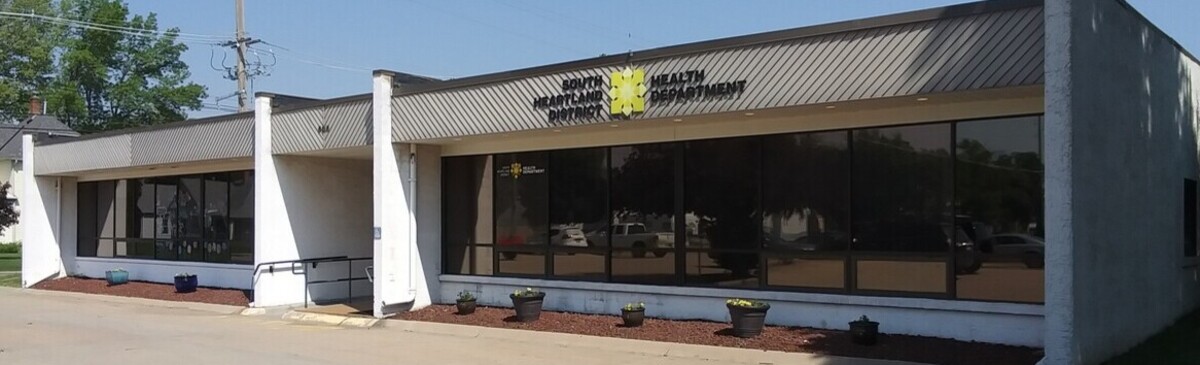
South Heartland District Health Department distributes short-term test kits for $8.00 from our office at 606 N. Minnesota in Hastings. SHDHD’s radon testing kits are also available for purchase at the Nebraska Extension offices in Clay, Nuckolls and Webster counties, at the Library in Superior, and at the Clay County Health Department in Clay Center.
What can I do if my radon levels are higher than 4? Any residents whose test results are over 4 picocuries/liter are at risk and should consider taking further steps to protect their health by assessing and reducing radon levels in their homes. Contact the health department or a licensed radon mitigation business for next steps to reduce the radon levels in your home. https://dhhs.ne.gov/Radon%20Documents/MitigationBusinessesReport.pdf
Should I get screened for lung cancer? If you smoke and are exposed to radon, your risks for lung cancer are higher. Lung cancer screening helps with early detection of lung cancer, especially for people with a history of heavy smoking. Webster County and Mary Lanning hospitals offer lung cancer screening through low-dose computed tomography (or CT) chest scans. If you are between the ages of 50 and 80, and have a history of heavy smoking (at least one pack/day for 20 years or more), and are a current smoker or quit within the last 15 years, you are considered high risk and may be eligible for lung cancer screening. Ask your health care provider if you should begin annual screening for lung cancer.
Where can I find more information? For links to more information on radon, radon testing, local radon test results and radon reduction methods, please visit the South Heartland District Health Department website at www.southheartlandhealth.ne.gov or call 402-462-6211 or 1-877-238-7595.
###
Michele Bever, PhD, MPH, is the executive director for South Heartland District Health Department, serving Adams, Clay, Nuckolls and Webster Counties in Nebraska. She may be reached at 402-462-6211 or toll free at 877-238-7595.